New Zealand has the appearance of a land shaped by giants — where sky-piercing peaks, expansive glaciers, and chiseled alpine valleys present one stunning vista. Centered in this monumental topography is the country’s highest and most iconic peak, Aoraki / Mount Cook, which the Māori call the “cloud piercer.” Its 3,724-meter summit sparkles in sunlight, ringed by frozen glaciers and blue-green lakes that transform this area into one of the world’s most beautiful natural treasures.
For those who cherish nature, climbing, or serene mountain strolls, New Zealand’s alpine universe is alive — raw, untamed, and spiritually enriching. Silence here is otherworldly; it resonates with wind, sonorous waterfalls, and the sound of glidingice.
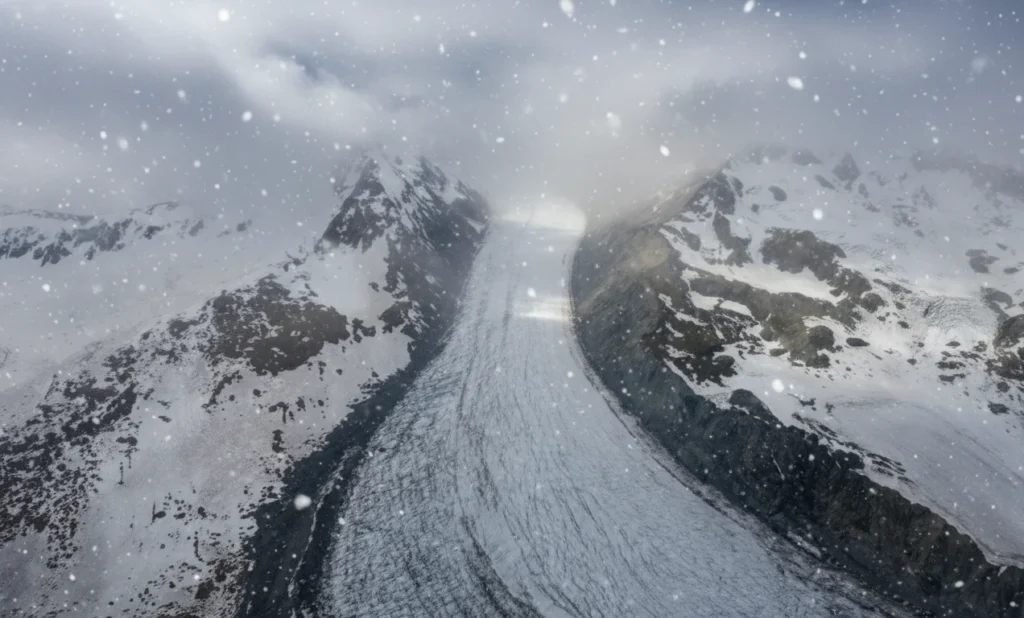
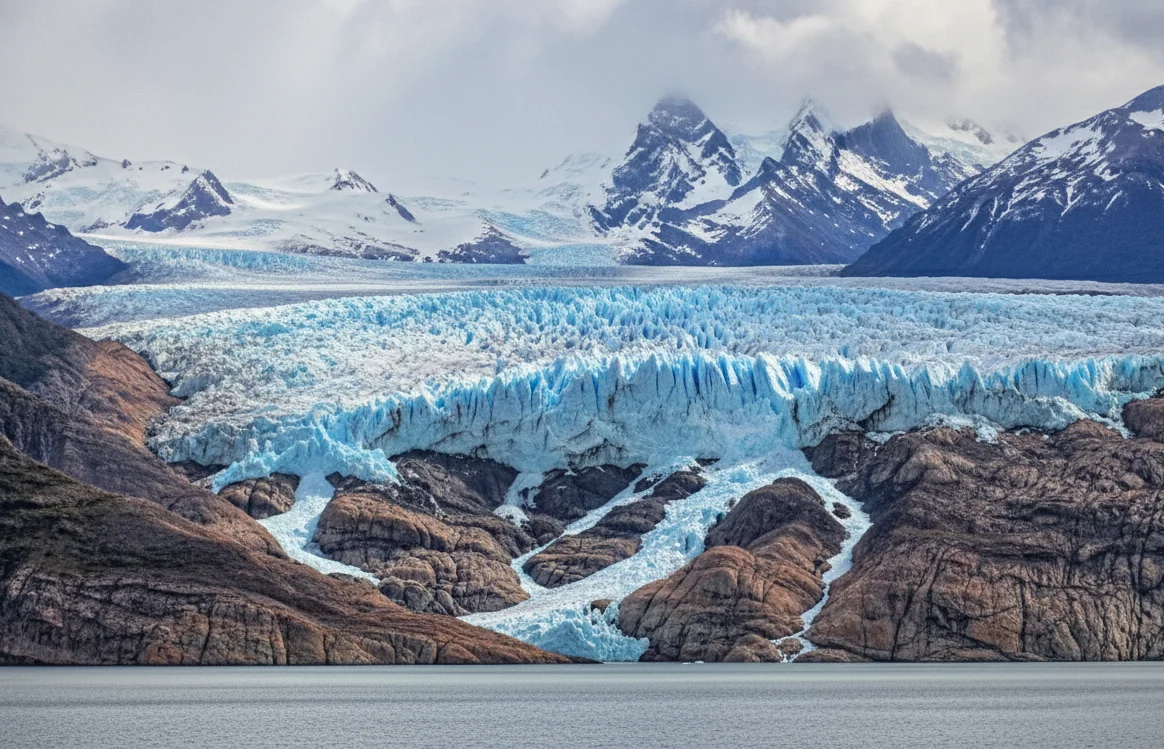
Stretching along the South Island for almost 500 miles, the Southern Alps make up the dramatic backbone of the country. They shoot up sharply from the plains, encasing older glaciers such as the Tasman Glacier, and gouging out valleys that support crystal lakes and dense beech forest.
It’s not the view alone that snares tourists — it’s the atmosphere. Standing in front of the Alps, the air is fresher, the globe quieter. The alpine kea parrots fly overhead, flashes of orange wings a brief sight, and tiny alpine flowers in color burst forth in spite of the chill. With each bend of the path, something surprises — a secret ice cave, a chattering stream, or sunlight bursting from behind the clouds.
To most tourists, this range appears even more unspoiled and wilder than Europe’s Rockies or Alps.
1. Aoraki / Mount Cook — New Zealand’s Tallest Peak (3,724 m)
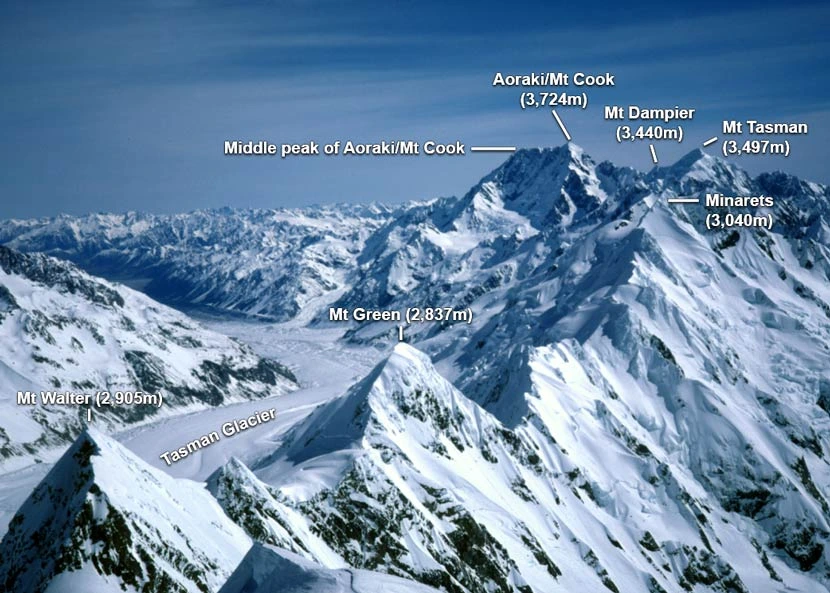
Towering high at 12,218 feet, Aoraki / Mount Cook towers over the landscape of Aoraki / Mount Cook National Park. Its three peaks — High, Middle, and Low Peak — stand above the gigantic Tasman Glacier, a river of ice over 14 miles long across the valley.
The name Aoraki, or “cloud piercer,” is aptly descriptive of its presence. When sunlight catches its upper ridges, it appears as if the sky curves around it.
Mountaineers visit here for some of the world’s premier alpine routes, but recreational travelers can stroll along the Hooker Valley Track, New Zealand’s most stunning walking track. Swinging bridges traverse glacial rivers along the way, and the vistas unfold to the snowy face of the mountain. Scenic flights are taken by many to view the huge crevasses and snowfields from the air — an image that remains with you for life.
It was here that Sir Edmund Hillary prepared himself prior to climbing Mount Everest, and his ghostly presence still seems to haunt among these snowy peaks.
Feature
Details
Height
3,724 m (12,218 ft)
Glacier nearby
Tasman Glacier
Best time to visit
Summer months: November – March
Notable activity
climbing Mount Cook, glacier tours
2. Mount Tasman — Majestic Second Highest Mountain (3,497 m)
Right beside Mount Cook stands its towering companion, Mount Tasman — often called the “brother peak.” At 3,497 meters, it rises sharply with the glittering Caroline Face, a near-vertical ice wall that challenges even the most experienced climbers.
Named after Abel Tasman, Dutch explorer, this peak is to be respected. Reaching its summit is an accomplishment that requires skill, but visitors need not ascend to feel its greatness. Helicopter rides soar over its glaciers, and those on earth may enjoy serene valley strolls and far-off views of its icy crest.
As sunlight colorizes the slopes in shades of gold and pink at sunrise, Mount Tasman glows like a torch from within — an image not easily forgotten.
3. Mount Dampier — Hidden Gem of the Southern Alps (3,440 m)
Between Mount Hicks and Mount Cook, Mount Dampier nestles like a less crowded but intensely beautiful mountain. Climbers traverse its ridges while climbing the North Ridge route of Aoraki. The serrated edges of the mountain and ice-covered steep walls tell of challenge and loneliness.
Its Māori name, “long sky,” is appropriate for a summit that regularly disappears and reappears in waves of passing cloud. Unlike its more renowned neighbors, however, Dampier provides a feeling of solitude — a reminder that the Alpine wild heart still pulsates far from throngs and lenses.
4. Mount Silberhorn — Iconic Snow-Capped Peak (3,300 m)
Its shining white slopes, Mount Silberhorn appears to be sculpted out of pure light. The name, “silver horn” in German, fits the way it reflects sunlight and shines against the blue.
Although shorter than Mount Cook or Tasman, Silberhorn’s refined outline makes it the most photographed peak in the area. Climbers ascend for technical climbing practice, while nature enthusiasts stand in the foreground in awe, photographing it through camera lenses and memory. It’s the sort of mountain that doesn’t scream for attention — it just glows.
5. Mount Aspiring / Tititea — The ‘Matterhorn of the South’ (3,033 m)
Deep within Mount Aspiring National Park, a UNESCO World Heritage area, towers Mount Aspiring / Tititea — alternatively referred to as the Matterhorn of the South because of its pyramid-like, sharp peak.
It’s a mountain that evokes respect and awe. Valleys surrounding the mountain are etched with tracks such as the Rob Roy Glacier Walk, where climbers listen to the echoes of cracking ice shifting and the sound of alpine streams in the distance.
For veteran climbers, its steep ridges are challenging thrills. For others, even seeing it in the distance is satisfying — a reminder of nature’s subtle strength. Tititea is “gleaming peak” in Māori, and when sunset reaches its summit, it certainly does the name justice.
Other Notable Peaks in New Zealand
Aside from the popular five, numerous lesser-known giants contribute their own character to the scenery. Mount Hicks is famous for the Linda Glacier, and Lendenfeld Peak is named for an Austrian explorer. Mount Sefton amazes guests with its vertical cliffs, and Mount Graham guards the mythical Milford Track, one of the world’s most beautiful treks.
Every peak has its own beat, its own voice within the great alpine chorus that makes the mountains of New Zealand so legendary.
Adventure Activities Around These Mountains
Adventure here is raw and unadulterated — born of the earth. During summer, trekkers walk on trails such as the Hooker Valley or Sealy Tarns Track and breathe fresh mountain air. In winter, heli-skiers pursue powder snow over virgin slopes around Franz Josef Glacier and Fox Glacier.
Glacier tours expose blue ice tunnels, while scenic flight reveals views to places inaccessible on foot. All activities — from easy walks to hair-raising climbs — connect visitors to something real, raw, and deeply emotive.
Tips for Visiting New Zealand’s Mountain Regions
Your experience is season-dependent. Summer (November to March) season is characterized by long, clear days that are great for hiking and photography. Winter makes the peaks a snow paradise but requires additional caution owing to avalanche dangers.
Always check predictions and bring suitable equipment. The Department of Conservation (DOC) maintains tracks and issues accurate safety updates. Locals are notoriously welcoming — always ready with a yarn or tip for travelers venturing into the bush.
Yes, it snows in winter, especially in the Southern Alps and South Island ski regions.
Why New Zealand’s Peaks Are World-Famous
What makes these mountains unique isn’t necessarily their elevation — it’s their character. Here, rainforests collide with glaciers, snow turns to fern-lined valleys, and the horizon stretches on forever. The world witnessed this wonder in The Lord of the Rings movies, but being here is so much more impactful than any film moment.
The legacy of explorers like Sir Edmund Hillary lives on in every climber who looks up at Aoraki and dares to dream. These mountains are more than landmarks — they’re part of New Zealand’s identity, a reminder that nature still has places untouched and pure.
— Greg Child
Why It’s Unique
Few nations compress so much diversity into such a compact space. Within one day, you can hike from sun-kissed beaches to glacial snows. The Southern Alps provide that unusual combination of proximity and remoteness — near enough to access, yet far enough away to be revered.
When to Visit
For trekking and photographing scenery, November to March provides warm days and open trails. For winter sports and snow enthusiasts, June to August is best, with stunning alpine conditions.
How to Reach
Most tourists start their mountain holidays from Queenstown or Christchurch. From there, scenic roads or short domestic flights take travelers to places like Mount Cook Village or Wanaka, which serve as access points to the Southern Alps and Mount Aspiring National Park.
Adventure Level
Moderate to extreme — your choice. Easy valley strolls are available to casual hikers, but even experienced climbers can put their mettle to the test on frozen ridges that have proved too much for the world’s top mountaineers.
Easy: Hooker Valley Track, Key Summit Trail
Moderate: Routeburn Track, Roy’s Peak
Challenging: Mount Aspiring climbs, Aoraki alpine routes